Most South African schools have no computers, yet the curriculum now expects children to learn coding. A project born at Nelson Mandela University found a way around that with puzzle pieces and a cellphone, and it has since reached learners on five continents.
Around 16 000 of South Africa’s roughly 24 000 schools have no computers. Many have no electricity or internet either. Coding and robotics now sit in the curriculum from Grade R to Grade 9, so the obvious question is how children are supposed to learn to code without the machines that run the code.
Tangible Africa has spent the past few years answering that question. The project teaches coding without computers, using tokens shaped like puzzle pieces and a single smartphone. It has reached more than 350 000 learners and introduced about 50 000 teachers to its methods. It now operates in nine African countries as well as Ireland, South Korea, Cyprus, Germany and Indonesia.

The problem nobody wanted to talk about
Professor Jean Greyling, Head of the Department of Computing Sciences at Nelson Mandela University in Gqeberha, called it the “elephant in the room” when he spoke at the 4th Universities South Africa (USAf) Higher Education Conference in Tshwane.
Infrastructure is only part of it. By his own estimate, which he stressed was not scientific and probably conservative, 90% of teachers are not qualified to teach coding. A policy can add a subject to the timetable. It cannot put a laptop on every desk or train a teacher overnight.
For more than 25 years, Prof Greyling visited rural, township and urban schools across the Eastern Cape trying to spark an interest in computing. Often he was speaking to children who had never seen a computer, in classrooms without power. “I had this sinking feeling that I was talking into a vacuum and I was not having any real impact,” he said.
An honours project that changed the plan
The turning point came in 2017. Byron Batteson, one of his honours students, walked into his office and said: “Prof, I want to introduce coding to learners who do not have computers.”
Batteson built TANKS, a game that pairs physical coding tokens with smartphone image recognition. Prof Greyling calls it “the best honours project I’ve supervised in 30 years” and credits Batteson with laying the foundation for everything that followed. Batteson is now a senior software engineer at Amazon.
How unplugged coding works
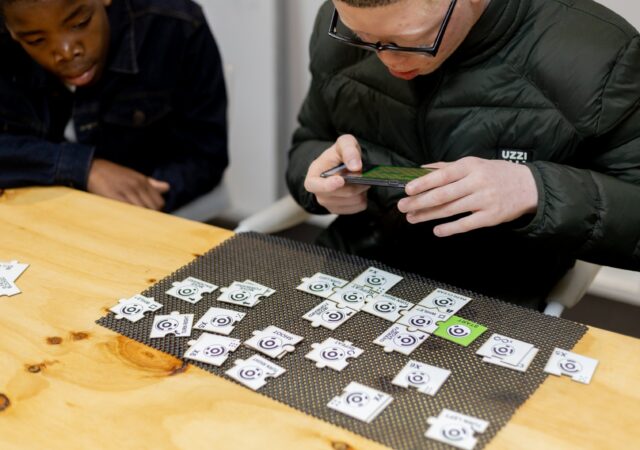
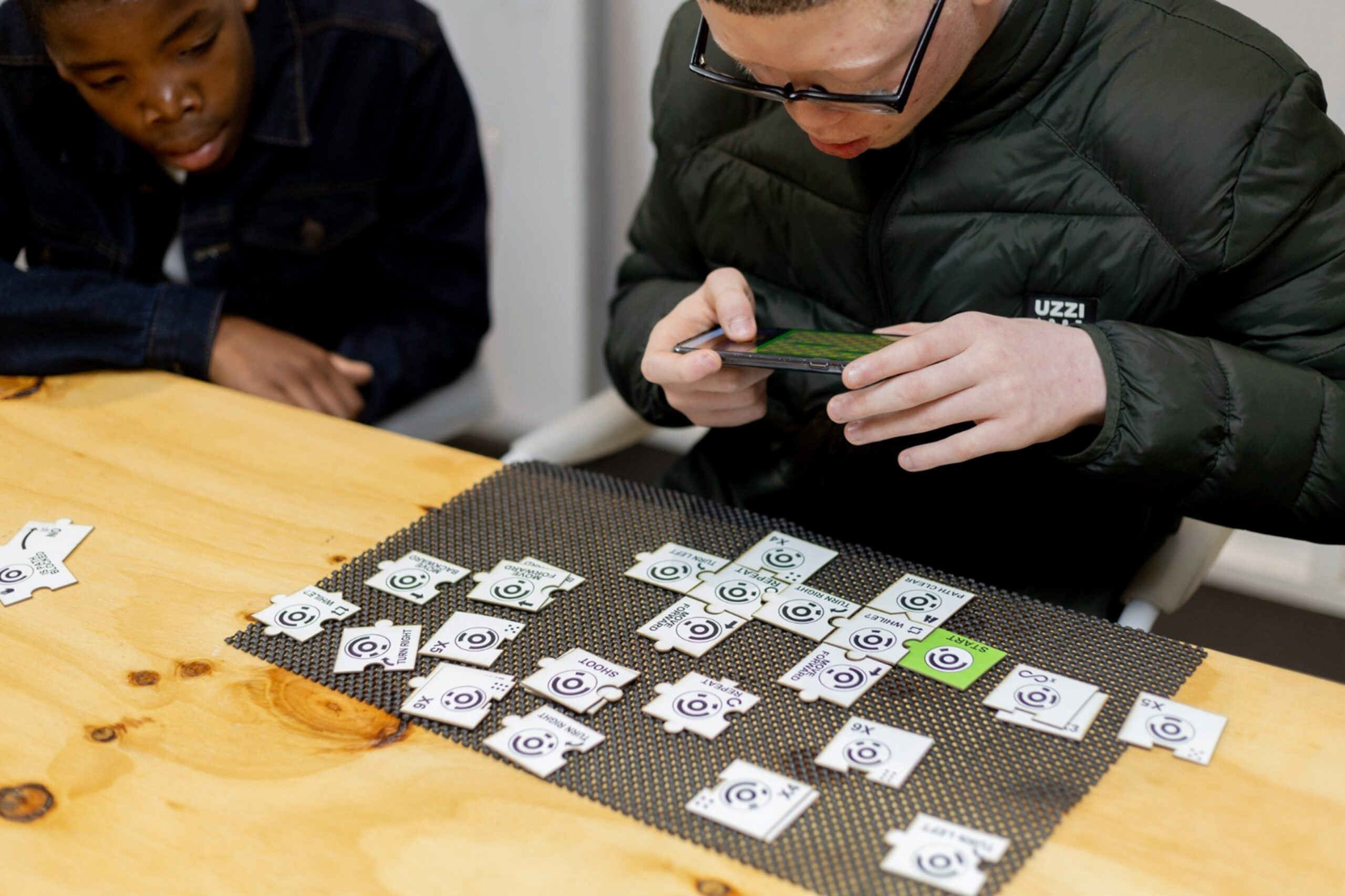
The method is simple, and that is why it works. Each token stands for one of the same coding instructions Prof Greyling teaches first year university students. Learners receive a challenge on a phone, work in groups to build their program by arranging the pieces, take a photograph and watch the code run. No computer, electricity or internet connection is needed in the classroom.
Teachers can be trained in three hours and use the tools the next day. Prof Greyling is firm that the experience must also be enjoyable, especially for younger children. “If you take the fun aspect away, you are going to lose them,” he said.
“Tangible starts by making learning fun and accessible for both teachers and learners, while teaching the fundamentals of computational thinking and problem solving,” he explained. “Through the process, many learners gain the confidence to pursue mathematics, which is essential for STEM careers.”
Cost is built into the design. The project runs on a low budget, and where possible no budget, principle. By Prof Greyling’s estimate, about 90% of the schools that benefit pay nothing, with corporate partners covering the cost. The tools have also been adapted for blind learners using braille and 3D printing. A young blind man who has followed the project will join as an intern next year to train other blind learners.
When coding becomes a spectator sport
Tangible Africa has also turned coding into competition. Its biggest tournament, held during Mandela Month in July, began with 30 learners in 2018. This year it drew 50 000 learners from 500 schools, who used the project’s products 220 000 times in a single month.
Last year the project ran an online coding World Cup with 340 teams from 30 countries. South African schools took first and second place, finishing ahead of Indonesia, the previous year’s champion.
Why it matters beyond coding
Behind the games sits a bigger goal. Everything Tangible Africa does is grounded in computational thinking, “or in an easier word, problem solving”, as Prof Greyling put it. Those are skills for life, not only for writing software.
He is doubtful that the national coding and robotics curriculum will be implemented well given the state of school infrastructure, so the project is helping teachers close the gap. A chatbot delivers CAPS aligned lessons from Grade R to Grade 7, one a week per grade, and a teacher needs only a phone and a printer to use it. Coding clubs then guide Grade 9 learners through coding, design thinking, entrepreneurship and STEM careers, showing them why mathematics matters before they choose their Grade 10 subjects.
That timing is deliberate. Prof Greyling shared what he called “a scary statistic”: only 24% of Western Cape matriculants take mathematics, while 76% take mathematical literacy. For a country trying to build a digital economy, that choice at the end of Grade 9 shapes careers.
Recognition at home and abroad
The project is an engagement initiative of Nelson Mandela University’s computing department and is run day to day by the non profit Leva Foundation. It won the 2024 Institute of Information Technology Professionals South Africa (IITPSA) President’s Award and has been through two global evaluations, including the UNICEF led Learning Cabinet. In 2025 it was one of 23 case studies selected for USAf’s Impact Initiative, which showcases the societal impact of South Africa’s universities.
Prof Greyling believes the project has helped make unplugged coding acceptable across the country, to the point where the Foundation Phase curriculum is now entirely unplugged.
One workshop, one turning point
The clearest measure of its impact may be one young man’s story. Katlego Nyambi told the conference that by Grade 11 he was “directionless”. Then his school sent him to a Tangible Africa workshop.
“One of the most important things Tangible gave me was a clear direction, something to work towards,” he said. He became fascinated by programming, began researching computer science courses at universities across the country and, for the first time, set real targets for his marks. “Because I do it more, I enjoy it, and because I enjoy it, I do it more.”
Prof Greyling filled in the rest. After that first workshop, he wrote to tell Nyambi that his marks were not good enough to study computer science. Six months later, Nyambi sent him his new results. His average had risen by 20%.
Today he is a second year computer science student at the University of Pretoria, on an Amazon bursary. He still does not know why his school chose him for that workshop, “but they did”, he said. He is now “so in love with programming and everything computers, all because of that one point in time”.

The bigger lesson
Debates about education in South Africa often stop at what schools lack. Tangible Africa starts with what they have: a teacher, a phone and a group of curious children. It shows that coding without computers is a practical way for learners to learn the problem solving the digital economy demands, and for some of them, it is where a career begins.